A Third of Entry-Level Jobs Now Ask for AI Skills. Employers Want Something Else More.

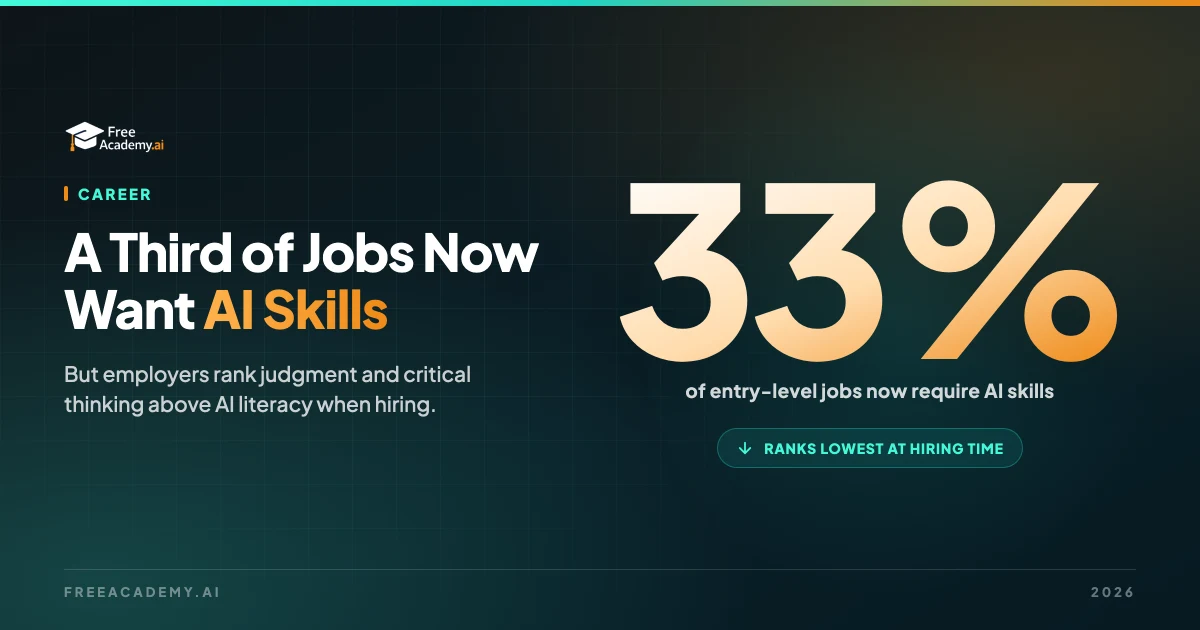
Two facts from this year's hiring data sound like they contradict each other. First: employers say more than a third of entry-level jobs now require AI skills, nearly triple the share from fall 2025. Second: when the same kinds of employers rank what actually matters in a new hire, AI literacy comes last, behind critical thinking and communication.
Both are true, and together they say something more useful than either headline alone. This post walks through the numbers and what to do about them, especially if you are a student or early in your career.
The Demand Side: AI Skills Went From Optional to Expected
The National Association of Colleges and Employers (NACE) surveyed employers in 2026 and found that demand for AI skills in entry-level jobs has nearly tripled since fall 2025. The numbers worth remembering:
- More than one third of entry-level jobs now require AI skills, per the employers surveyed.
- 28% of employers say they specifically seek early-career talent who can use AI in their work.
- Nearly 60% assign interns projects that use AI tools, which means the expectation reaches you before your first real job.
What counts as "AI skills" here is mostly applied use: working with AI tools, prompting well, using AI for data analysis, automating small workflows, and judging whether AI output is good. Employers are not asking new graduates to train models. That distinction matters, because the applied tier is learnable in months, not years.
The Ranking Side: Judgment Still Beats Tools
Here is the twist. Research from the Strada Education Foundation on entry-level hiring in the AI era asked employers to rank the skills they evaluate in early-career hires. Critical thinking and communication came out on top. AI literacy ranked at the bottom of the list.
So which is it? Do employers want AI skills or not?
They want both, in a specific order. AI skills have become a filter: their absence screens you out, the way "can use Excel and email" once did. But their presence does not win you the job. What wins the job is what you do with the tools: framing a problem, judging output, and explaining a result to another human.
The same research adds a striking detail: AI-exposed entry-level roles are about seven times more likely to require traditionally senior-level skills like judgment and leadership. The logic is simple. When AI does the routine production, the routine parts of junior jobs shrink, and what remains is the part that used to make someone senior: deciding, checking, and communicating.
What This Means: The Bar Moved Twice
Put the two datasets together and the picture for a new graduate looks like this:
- You need AI fluency to be considered. A third of entry-level postings filter on it, and the share is climbing fast.
- You need demonstrated judgment to be chosen. The interview is won by how you think, not by which tools you list.
Notice that "prompt engineering" appears in the in-demand skill lists and yet does not, on its own, differentiate you. Everyone applying next year will claim it. The differentiator is applied judgment: can you take a messy, real task, use AI to do it faster, catch where the AI is wrong, and present a result you can defend?
How to Prove It, Concretely
The NACE data also asked hiring managers what evidence convinces them. Three answers stood out: industry-recognized certifications (49%), a personal project portfolio (39%), and internship or freelance experience (37%).
That maps to a plan:
Get one credential, not ten. A certificate signals baseline fluency. A wall of them signals certificate collecting. Our guide to free AI certifications employers value covers which ones are worth the time. Every FreeAcademy course includes a free certificate and a final exam, so the credential reflects something you did.
Build one project that shows judgment. Not a demo that follows a tutorial. Take a real problem from your field, use AI on it, and write up what the AI got wrong and how you fixed it. That last part is the judgment evidence, and almost nobody includes it. The AI for Job Searching & Career Growth course covers how to present this kind of work.
Practice the human layer deliberately. Critical thinking and communication top the employer rankings, and they are trainable. Every time you use AI, make yourself state why you accept or reject its output. Then practice explaining the result in plain language. That habit is the whole skill.
If you are starting from zero, our free AI learning path for students sequences the fluency part, and the 5 AI skills that make you irreplaceable covers the durable layer above the tools.
Key Takeaways
- AI-skill requirements in entry-level jobs nearly tripled in a year. Over a third of entry-level roles now ask for them, and 60% of employers give interns AI projects.
- Yet employers rank critical thinking and communication above AI literacy when choosing whom to hire. AI skills get you considered. Judgment gets you picked.
- AI-exposed junior roles are about seven times more likely to demand traditionally senior skills, because AI absorbs the routine work.
- The evidence that convinces hiring managers: one solid certification, one portfolio project that shows you catching AI's mistakes, and any real-world experience.
- Learn the tools quickly, then spend your effort on the layer above them. That order is what the data supports.
Enjoyed this article?
Join The FreeAcademy Weekly
One practical AI email every Tuesday. New free courses, AI tips, and a short note from the founder.
Free forever. Unsubscribe anytime.
Related articles
Best Free AI Certifications That Actually Matter to Employers (2026)
The best free AI certifications employers actually value in 2026. Compare top options, learn which credentials stand out on a CV, and where to get started.

The 5 AI Skills That Will Make You Irreplaceable in 2026
Discover the five AI skills that employers desperately need but struggle to find. Learn what separates AI-augmented professionals from those being replaced, and how to future-proof your career.

Free AI Learning Path for Students in 2026: Beginner to Job-Ready
Follow this free AI learning path for students in 2026. Discover the best ai for students free course options to go from beginner to job-ready.