Build autonomous AI agents with Python using LangChain and LangGraph. Learn tool calling, stateful workflows, RAG-powered agents, multi-agent systems, and production deployment. From the ReACT pattern to a full customer support agent capstone.
This free course teaches you how to build autonomous AI agents with Python using LangChain and LangGraph. Starting from first principles, you will learn what makes a system truly "agentic", then work through the Python tools and frameworks that make agent development practical in 2026. The course progresses from tool calling and function use through stateful agent design with LangGraph, giving you the architectural vocabulary to build agents that persist context across turns and take multi-step actions independently.
The middle modules tackle two of the hardest practical problems in agentic AI: giving agents long-term memory via retrieval-augmented generation (RAG), and coordinating multiple specialized agents that collaborate on a shared goal. You will see how multi-agent systems are structured and where they outperform single-agent approaches. The final lessons cover production deployment so your agents can run reliably outside a notebook, and the course closes with a capstone project where you build a complete customer support agent from scratch.
This course is designed for Python developers and technically curious learners who already have some coding experience and want to move beyond basic LLM calls into genuinely autonomous systems. No prior LangChain knowledge is required. Completing the course and passing the final exam earns a certificate of completion you can add to your LinkedIn profile or resume, demonstrating hands-on experience with one of the most in-demand skill sets in applied AI today.
10 modules • 10 lessons
Finish every lesson and pass the final exam to earn this free, shareable certificate.
Certificate of Completion
has successfully completed
10 lessons · Final exam passed

Michail Ouroumis
Founder, FreeAcademy.ai
Sample preview. Your name appears on the certificate when you complete the course. Learn more
Teaching a class or training a team? Assign this course for free
The course walks through the full agent development stack: what AI agents are, how to set up the Python environment, tool calling, stateful workflows with LangGraph, memory and RAG, multi-agent systems, and production deployment. It closes with a capstone project building a customer support agent end to end.
Yes, the course is completely free. You can work through all modules at your own pace, and finishing the course plus the final exam earns a certificate of completion at no cost.
You should be comfortable writing Python functions and working with libraries. Prior experience with LangChain or LangGraph is not required, as the course introduces both frameworks from the ground up.
The course is built around LangChain and LangGraph for agent orchestration and stateful workflows. You will also work with tool calling patterns, retrieval-augmented generation techniques, and production deployment practices relevant to real Python agent projects.
Yes. Completing all lessons and passing the final exam earns a certificate of completion that you can share on LinkedIn or include on a resume to show practical experience building agentic AI systems.
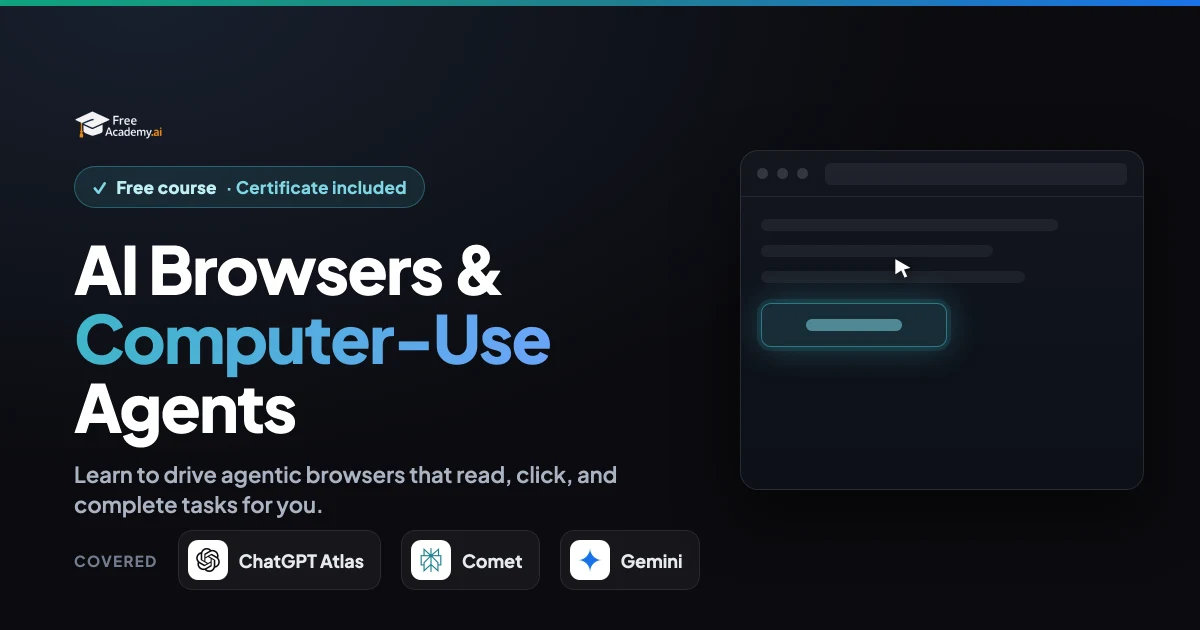
A practical, no-code guide to the new class of AI browsers and computer-use agents that browse and act on your behalf. Learn how they work, compare ChatGPT's browsing agent, Perplexity Comet, and Gemini in Chrome, run real research and automation workflows, steer them safely, and defend against prompt injection and data exposure. Earn a free certificate.
Build a working AI agent from scratch in Python. Learn the think-act-observe loop, call an LLM, give your agent a tool it can use, and handle a failed tool call. Framework-agnostic and beginner-friendly.

Learn to build multi-agent AI systems with CrewAI in about 45 minutes. Understand the crew/agent/task model, define specialized agents, create tasks, and build a real-world market research crew with analyst, researcher, and writer agents.
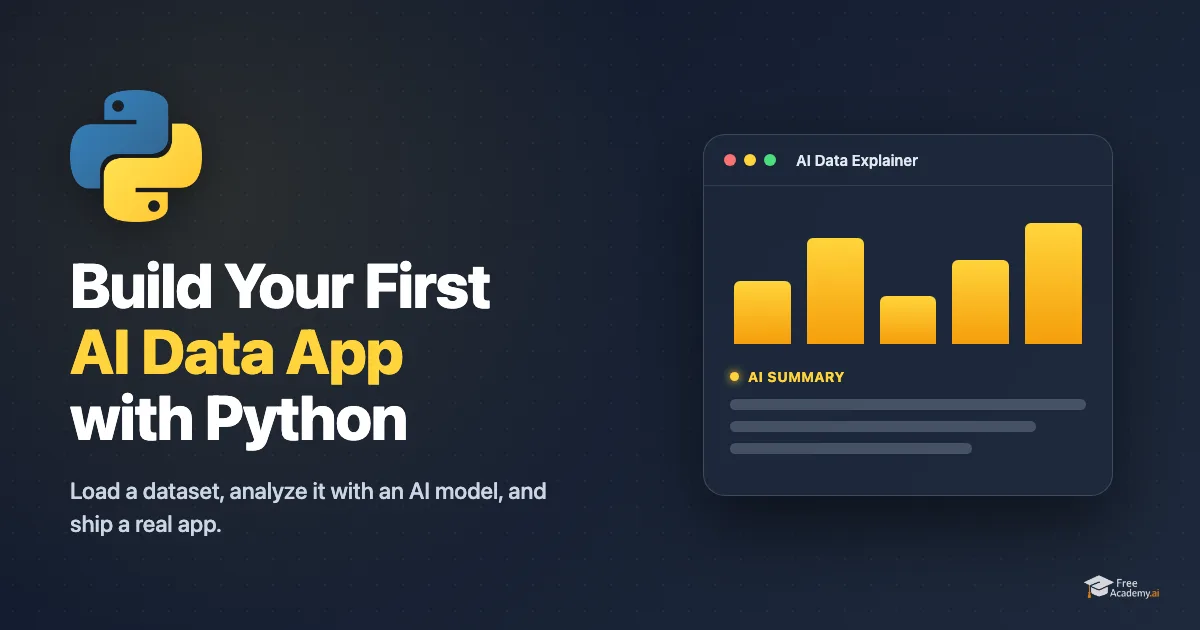
Already know basic Python? Build one real thing end to end: a small AI data app that loads a dataset, sends a slice of it to a language model, and turns the response into a written analysis. You will use pandas only as much as the app needs, call an LLM API directly (no agents, no frameworks), wire the pieces into a single script with real error handling, and ship it as a shareable Streamlit app you can run locally. A project-based intermediate course with a free certificate of completion.

Move beyond chatbots. Build autonomous agents that work for business. Learn to create production-ready AI agents using JavaScript, TypeScript, Next.js, and the Vercel AI SDK. Perfect for JavaScript developers who want to build AI applications without learning Python.
Set up Hermes Agent, the open-source self-hosted AI assistant from Nous Research that writes its own reusable skills and keeps all your data on your own machine. A beginner-friendly micro course: understand what makes Hermes different, install it with a single command, run your first useful tasks, and stay safe with a practical permissions checklist. Prefer a chat-app interface instead? Try the OpenClaw micro course (/courses/micro-openclaw-ai-agent).