Last updated
Finally see how AI, machine learning, deep learning, and generative AI fit together. Learn where rules end and learning begins, what the "deep" in deep learning actually changes, when simpler machine learning still wins, and how to place any real product on the map. No code, no math.
Like this video? Get new free AI lessons on YouTube.
SubscribeAI, machine learning, deep learning, and generative AI get used as if they were the same thing, and most explanations either stay vague or dive straight into math. This short course gives you one clear map instead. You will see how the four terms nest inside each other, so ChatGPT can be generative AI, deep learning, machine learning, and AI all at once. You will learn the real line between classic AI and machine learning (who writes the rules), what the "deep" in deep learning actually changes (the network learns its own features from raw data), and why simpler machine learning still beats deep learning on tidy spreadsheet data and decisions that must be explained. Then you will place generative AI and large language models precisely, clear up common myths, and practice sorting ten everyday products, from route planning to face unlock to chatbots. By the end you can read any "AI-powered" claim and ask the questions that reveal how the system really works. It is a good first step before Introduction to Machine Learning (No Code) or How Neural Networks Actually Work, because every later topic fits somewhere on this map. No code and no math required, just curiosity about the tools you already use.
2 modules • 5 lessons
Finish every lesson and pass the final exam to earn this free, shareable certificate.
Certificate of Completion
has successfully completed
5 lessons · Final exam passed

Michail Ouroumis
Founder, FreeAcademy.ai
Sample preview. Your name appears on the certificate when you complete the course. Learn more
Teaching a class or training a team? Assign this course for free
They are nested, not competing. AI is any machine doing something we would call smart. Machine learning is the part of AI that learns its rules from examples. Deep learning is the part of machine learning that uses many-layered neural networks. Generative AI, like ChatGPT, is deep learning used to create new content.
No. Every idea is explained in plain language with everyday examples. There is no code and no math notation anywhere in the course.
That course goes deep on machine learning itself, including the types of learning, data, and building a real model. This course is the map around it: how machine learning relates to AI, deep learning, and generative AI, and how to tell them apart in real products. It works well as a first step before the longer course.
No. Deep learning shines on raw images, audio, and text, but it needs more data and computing power and is harder to explain. For tidy tables of data, small datasets, and decisions that must be explained, classic machine learning is often the better choice.
About 35 minutes across five short lessons. Each lesson has a quiz, and there is a final exam with a free certificate when you pass.
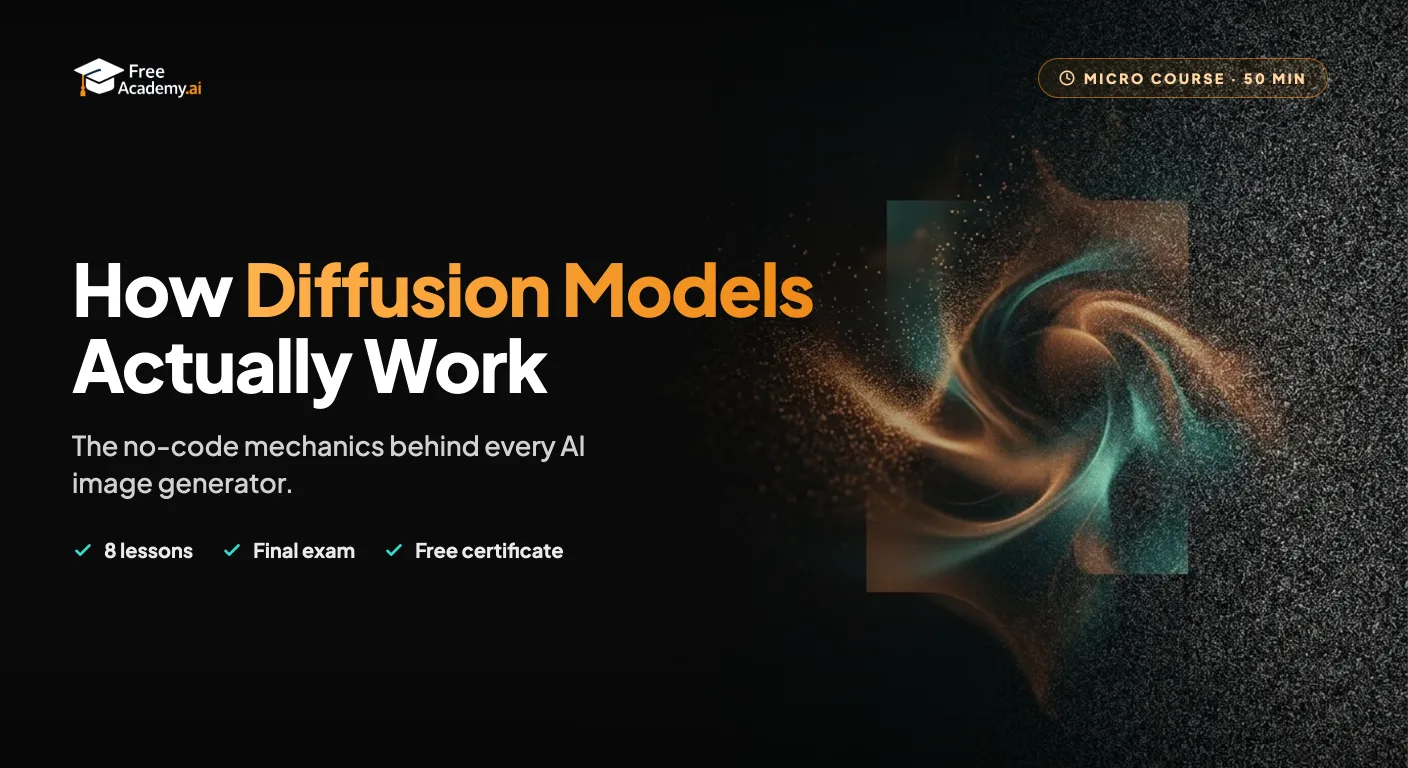
Understand how tools like Midjourney, DALL-E, and Stable Diffusion actually generate an image, in plain language with no code and no math. Learn what a diffusion model is, how starting from noise leads to a finished picture, what latent space is, how your prompt steers the process, and why diffusion beat older methods like GANs.
Understand the machine underneath modern AI without writing a line of code. Learn what a neuron does, why weights are the only place a model stores knowledge, how layers build their own concepts, and how training actually works through loss, gradient descent, and backpropagation.
Understand machine learning from the ground up — without writing a single line of code. Use ChatGPT, Claude, Gemini, Perplexity, and Google's Teachable Machine to build, test, and explain ML models. Built for university students and early-career learners with zero technical background. Earn a free certificate to add to your LinkedIn and resume.
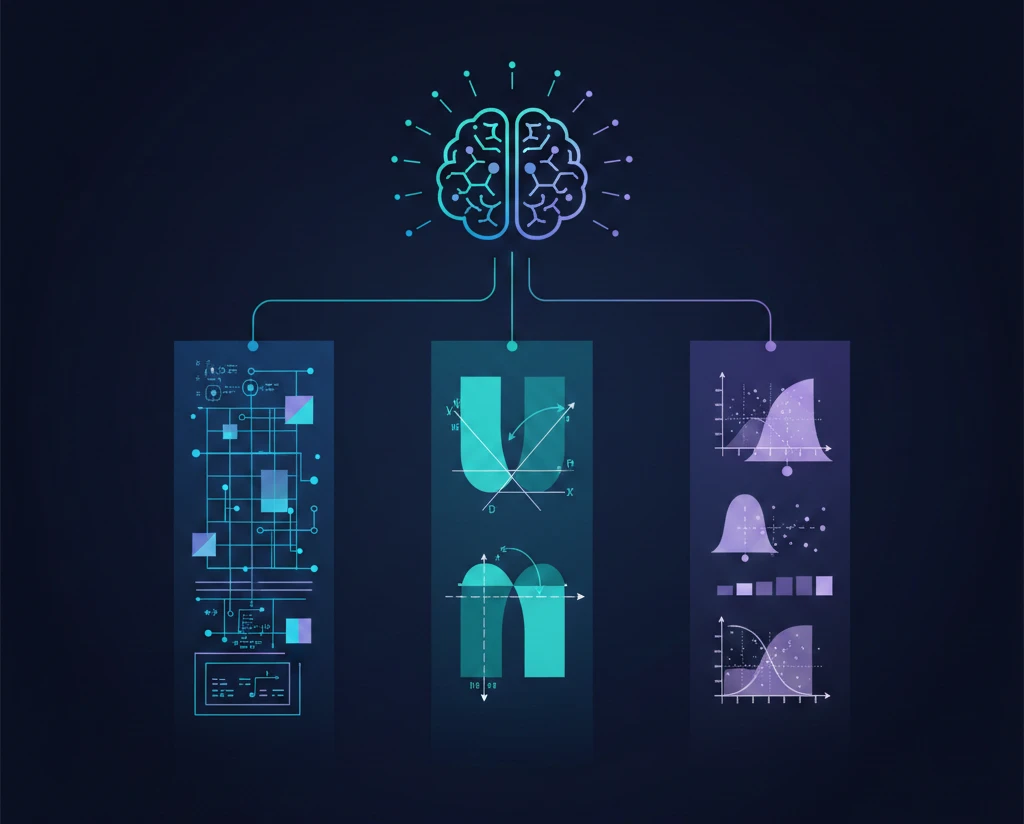
Bridge the gap between AI curiosity and AI understanding. Discover why linear algebra, calculus, and probability are the three pillars of artificial intelligence, see how each one powers real AI systems like neural networks and LLMs, and get a clear learning path to master them all.
Some AI models pause to "think" before they answer. Learn what reasoning models actually do, why thinking step by step helps, how models are trained to reason, when a reasoning model is worth the extra time and cost, how to prompt one well, and where their thinking still goes wrong. No code, no math.
Master the calculus that powers machine learning. Learn derivatives, partial derivatives, the chain rule, gradients, gradient descent, loss functions, and backpropagation — the essential math behind how models learn.