Go one level under the hood of ChatGPT, Claude, and Gemini. Understand tokens, next-token prediction, context windows, model parameters, Mixture of Experts, and why AI models cost money to run. A short, no-code course for people who use AI every day.
You use ChatGPT, Claude, or Gemini every day, but do you know what actually happens when you press enter? This free course takes you one level under the hood, without a single line of code or any math. In about forty minutes you will build a genuinely accurate mental model of how large language models work, the kind of understanding that makes you a sharper, more skeptical, and more effective user of every AI tool you touch.
You will learn how your words become tokens and numbers, why models are billed per token, and why they historically miscount the letters in a word like strawberry. You will see that a model is really a next-token predictor, which explains hallucinations, why the same prompt gives different answers, and what the temperature setting changes. From there you will understand the context window and why long chats drift, what the parameter count in a name like 70B really means, why bigger is not always better, and how Mixture of Experts lets modern models be huge yet fast. A final lesson connects training, fine-tuning, alignment, and inference, so you finally understand why a free chatbot still costs real money to run.
This course is written for students and working professionals who want to understand AI, not build it. Like every FreeAcademy course it is 100% free with no signup required to start, and when you finish the lessons and pass the final exam you earn a free certificate of completion for your LinkedIn profile or resume.
2 modules • 6 lessons
Finish every lesson and pass the final exam to earn this free, shareable certificate.
Certificate of Completion
has successfully completed
6 lessons · Final exam passed

Michail Ouroumis
Founder, FreeAcademy.ai
Sample preview. Your name appears on the certificate when you complete the course. Learn more
No. This is a fully no-code, no-math course. Every concept, from tokens to Mixture of Experts, is explained in plain language with everyday analogies, so a curious beginner can follow it comfortably.
It is for students and working professionals who use AI tools like ChatGPT, Claude, or Gemini and want to understand what happens under the hood. It is not an ML engineering career track; it is about becoming a smarter, more effective AI user.
It goes one level deeper on the mechanics: how tokenization works, how next-token prediction produces answers, what parameter counts mean, and how Mixture of Experts and inference cost work. These topics are rarely covered in a beginner-friendly, no-code way.
Yes. The full course is free with no signup required to start. When you finish the six lessons and pass the final exam, you earn a free certificate of completion you can add to your LinkedIn profile or resume.
About forty minutes. It is a focused micro course of six short lessons, each with a quick quiz, plus a final exam, so you can finish it in a single sitting.
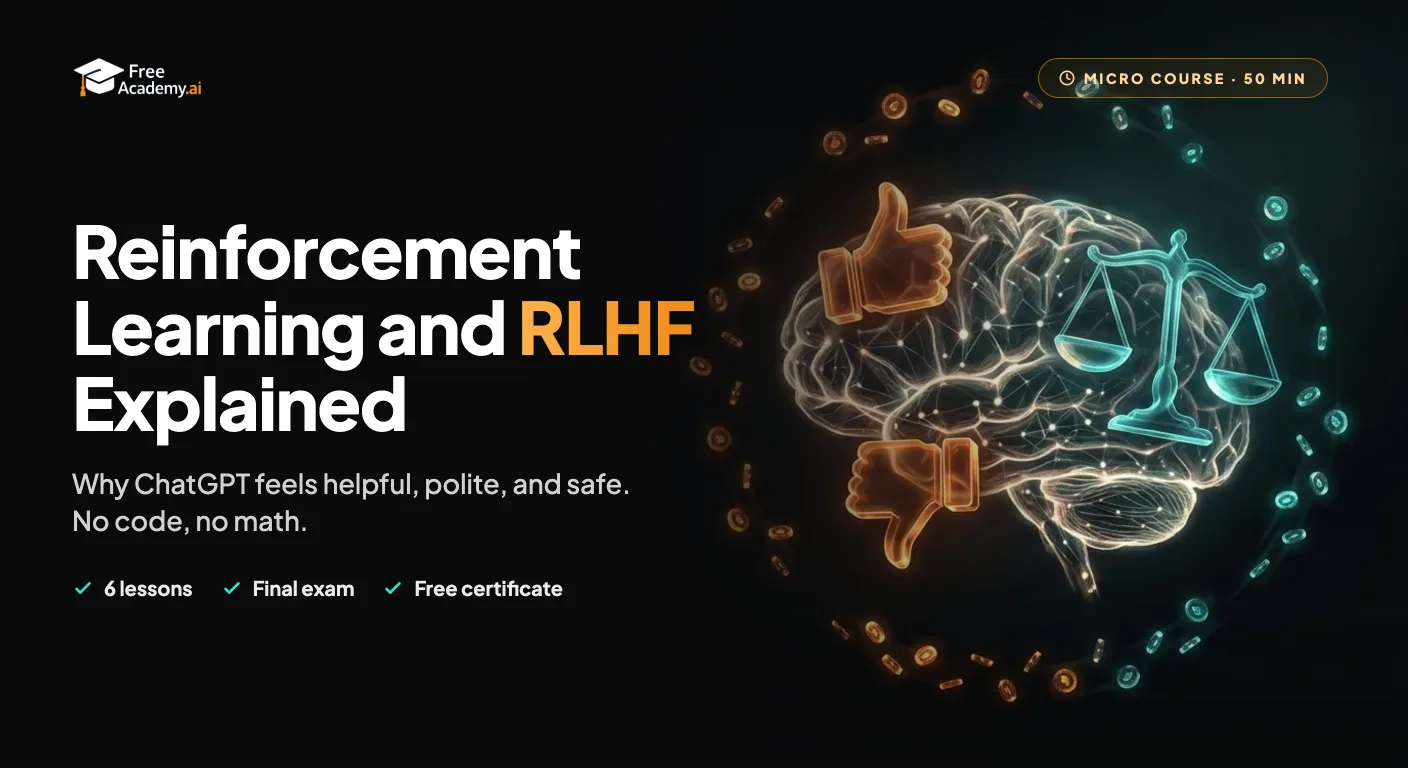
Find out why ChatGPT, Claude, and Gemini feel helpful, polite, and safe instead of just completing text. A short, no-code course on reinforcement learning, supervised fine-tuning, reward models, PPO and DPO, and the side effects of alignment like sycophancy and reward hacking. The natural next step after How LLMs Actually Work.
A short, no-code, no-math explainer of the attention mechanism that powers ChatGPT, Claude, and Gemini. Understand query, key, and value, why models use many attention heads, how word order is encoded, and why transformers read your whole prompt at once.
Understand the machine underneath modern AI without writing a line of code. Learn what a neuron does, why weights are the only place a model stores knowledge, how layers build their own concepts, and how training actually works through loss, gradient descent, and backpropagation.
Move beyond writing prompts to engineering them. Build evals and rubrics to measure prompt quality objectively, use AI to write and refine your prompts, get reliable structured outputs, and run optimization loops that cut variance, cost, and latency.

Master the fundamentals of artificial intelligence without the technical jargon. Understand what AI is, how it works, and how it's transforming our world. Perfect for complete beginners, business leaders, and anyone curious about the AI revolution. No coding required.
Master prompt engineering through hands-on exercises. Learn prompt structure, few-shot learning, chain-of-thought reasoning, and advanced techniques with instant feedback. Build real-world prompts for code generation, content writing, and data analysis.