Explore the intersection of economics and sustainability. Learn how economic principles can be adapted to address environmental challenges, climate change, resource management, and social equity. Perfect for students, policymakers, and anyone interested in building a sustainable future.
Sustainable Economics examines how economic thinking must evolve to address the realities of climate change, finite natural resources, and growing social inequality. This free intermediate course takes you from foundational economic principles through the limits of traditional GDP-focused models, then into environmental economics, climate change economics, and the circular economy, giving you a connected framework rather than isolated facts.
Across ten modules you will explore how environmental costs get priced into markets, how policy tools such as carbon pricing and regulatory standards shape business decisions, and how green innovation is creating new competitive opportunities. You will also examine social dimensions of sustainability and the metrics beyond GDP that governments and organisations use to measure genuine progress.
This course suits students studying economics, business, or environmental science, as well as professionals in policy, finance, or corporate sustainability who want a rigorous grounding in how economic systems can be redesigned for long-term resilience. No specialist background is required beyond a general comfort with intermediate-level concepts. Complete the course and pass the final exam to earn a certificate of completion you can add to your LinkedIn profile or resume.
12 modules • 12 lessons
Finish every lesson and pass the final exam to earn this free, shareable certificate.
Certificate of Completion
has successfully completed
12 lessons · Final exam passed

Michail Ouroumis
Founder, FreeAcademy.ai
Sample preview. Your name appears on the certificate when you complete the course. Learn more
Teaching a class or training a team? Assign this course for free
The course moves through economic fundamentals, the limits of traditional models, environmental economics, climate change economics, circular economy and resource management, sustainability metrics, green business innovation, policy tools, social dimensions, and pathways for building a sustainable economy. Each module is self-contained so you can revisit specific topics as needed.
Yes, the course is completely free and you can start learning without creating an account. If you want to track your progress and earn a certificate of completion at the end, a free account is all you need.
The course is designed at an intermediate level, so a basic familiarity with economics concepts such as supply, demand, and market incentives is helpful. You do not need a formal economics degree, and the early modules on economic fundamentals provide a solid refresher before the course moves into sustainability-specific topics.
The course covers a range of real-world mechanisms including carbon pricing, regulatory standards, green subsidies, and circular economy business models. There is also a dedicated module on green business and innovation, examining how companies are turning sustainability constraints into competitive advantages.
Yes. Completing all modules and passing the final exam earns you a certificate of completion that you can share on LinkedIn or attach to a resume. The certificate reflects your understanding of sustainable economics across the full scope of the course.
Master the art and science of pricing to maximize profitability. Learn pricing psychology, methods, policies, and execution strategies used by leading companies.
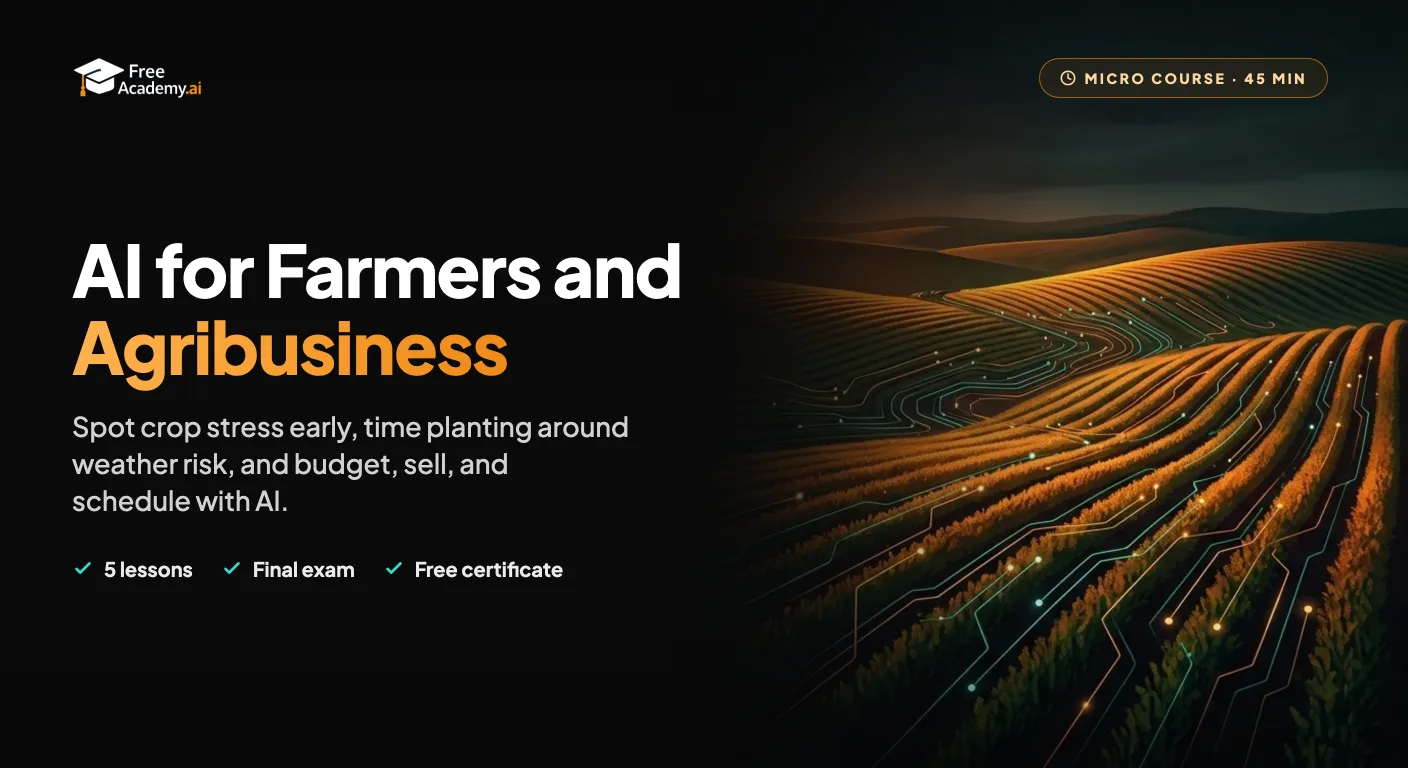
Use AI to run a farm or agribusiness better. Spot crop stress early, time planting and harvest around weather risk, budget for input costs, research markets before you sell, and keep supply orders and labor on schedule.
Master JSON parsing, manipulation, and transformation with hands-on exercises. Learn to navigate complex data structures, transform API responses, and build data pipelines in your browser.
Master data analysis with Pandas through hands-on exercises. Learn to create, manipulate, filter, group, and transform DataFrames in your browser. Practice real-world data wrangling with live Python execution.
Discover the economic forces driving AI products. Learn cost structures, pricing strategies, two-sided markets, compute commodities, and network effects through the lens of ChatGPT and other AI services.
Master the fundamentals of Amazon Web Services (AWS). Learn about cloud computing basics, core AWS services including EC2, S3, RDS, and Lambda, security best practices, and cost management. Perfect for developers, IT professionals, and anyone starting their cloud journey.