The music industry has a secret, and it's poorly kept: a huge portion of professional musicians, producers, and artists are already using AI in their work. They just don't want to talk about it.
As earlier reporting documented, the use of AI in music production has been an open secret. Now Rolling Stone has documented what many in the industry have quietly known for over a year: AI use in music production has crossed from experimental to mainstream. Songwriter Michelle Lewis put it plainly — it's widespread across genres, "but nobody wants to admit it." Producer Young Guru went further, estimating that more than half of sample-based hip hop is now made using AI-generated samples rather than licensed original recordings or live session musicians.
The Economics of the Shift
The logic from a producer's perspective isn't mysterious. Licensing a recognizable sample from a classic soul or funk record can cost tens of thousands of dollars. Clearances can take months. Rights holders can block a song entirely or demand royalty splits that gut the economics of a release.
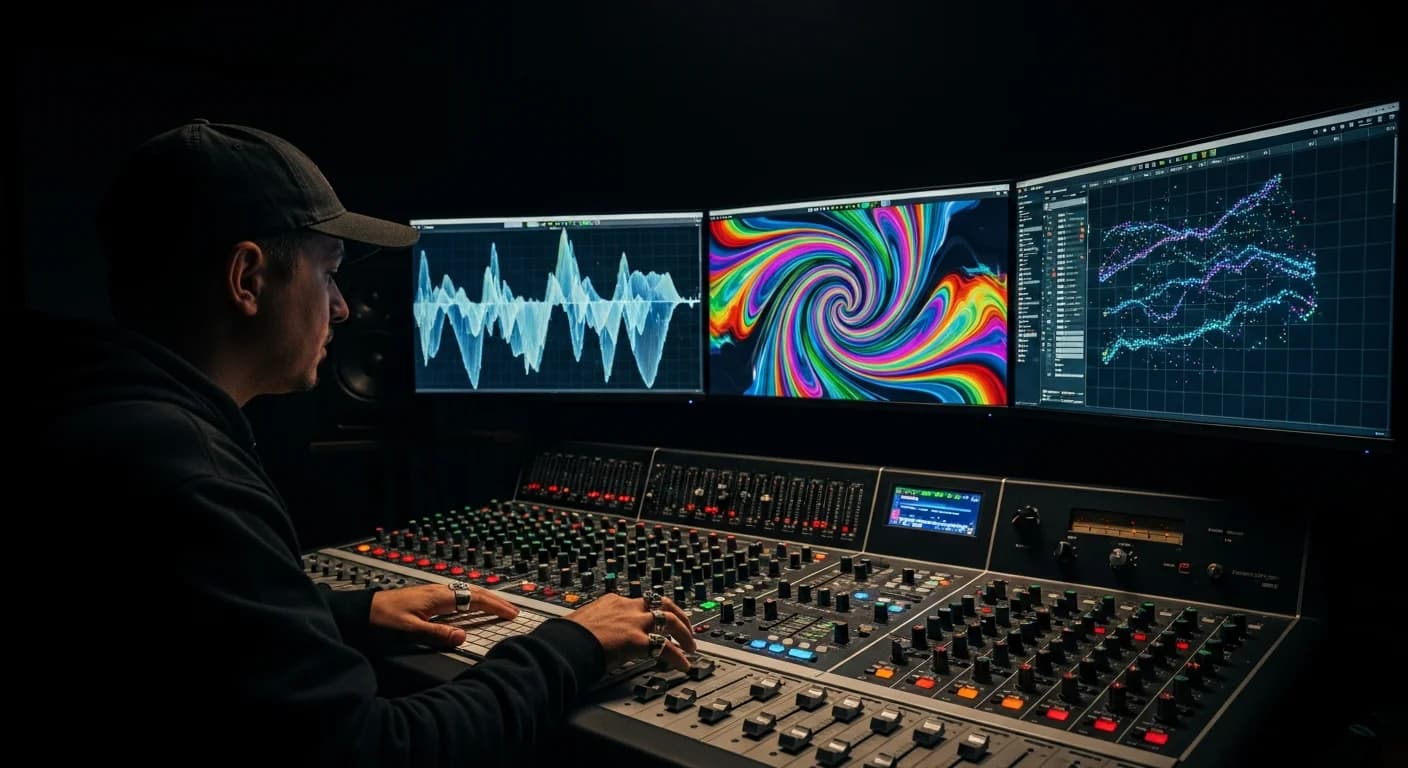
AI changes the math. Tools like Suno, Udio, and a growing field of specialized production software can generate a soul horn stab or a funk bass groove on demand, in seconds, for pennies. It's not identical to the real thing — yet — but for a bed track or a non-featured sample, it's often close enough for release.
For hip hop specifically, the sample has always been central. Entire aesthetic traditions — from boom-bap to trap to drill — are built on chopped and flipped recordings. As AI-generated audio becomes more convincing, using it instead of clearing original samples is becoming the obvious economic choice.
Why No One Talks About It
The silence is strategic and multi-layered.
Audiences have complicated feelings about AI in art. The backlash when AI involvement is discovered — particularly in music — tends to be swift and severe on social media. The "authenticity" premium is real, especially in genres like hip hop where connection to lived experience and cultural lineage is part of the value proposition.
Then there's the legal uncertainty. AI music generation tools are themselves in the middle of ongoing copyright litigation. Suno and Udio both face lawsuits from major labels arguing that their models were trained on copyrighted recordings without permission. If those suits succeed, music generated by those tools could be considered infringing. Artists using them have a reason to be quiet.
And there's no disclosure requirement. Unlike AI-generated images in some advertising markets, there's no legal or industry mandate requiring musicians to declare AI involvement in their creative process. The Grammy Recording Academy updated its rules in 2024 to allow AI-assisted music to be eligible for awards, as long as "a human created a meaningful portion." But what constitutes a "meaningful portion" remains undefined.
The Genre Gap
The phenomenon isn't uniform across music. Electronic and production-heavy genres have adopted AI tools fastest — they already treat software and synthesis as natural parts of the creative process, and AI generation is just another texture to work with.
Country music, which had a high-profile controversy over AI voice cloning in 2024, has also seen quieter adoption of AI-generated bed tracks and arrangements. Pop production pipelines, which are heavily software-mediated already, are experimenting with AI for arrangement sketches and reference demos.
Jazz and classical, with their emphasis on live performance and improvisation, have seen less adoption. But even there, AI is being used for transcription, analysis, and scoring tasks that would previously have required human specialists.
What Comes Next
The "don't ask, don't tell" equilibrium is probably temporary. As AI detection tools improve — and the major labels and publishers are actively developing them — the question of who used AI in what will become easier to answer forensically.
More significantly, the legal landscape is shifting. Multiple AI music generation companies are in litigation over training data. The outcomes of those cases will determine whether the AI-generated sample pipeline that Young Guru describes is legally sustainable, or whether the industry will need to construct a new licensing framework from scratch.
The pattern mirrors AI adoption in other fields — pharmaceutical companies are already using AlphaFold 3 for drug discovery, and the same "quietly adopted, publicly denied" dynamic played out before acknowledgment became inevitable.
Until then, the most honest description of where music and AI stands right now is also the simplest: the technology has already won. The cultural and legal infrastructure to acknowledge that hasn't caught up yet.