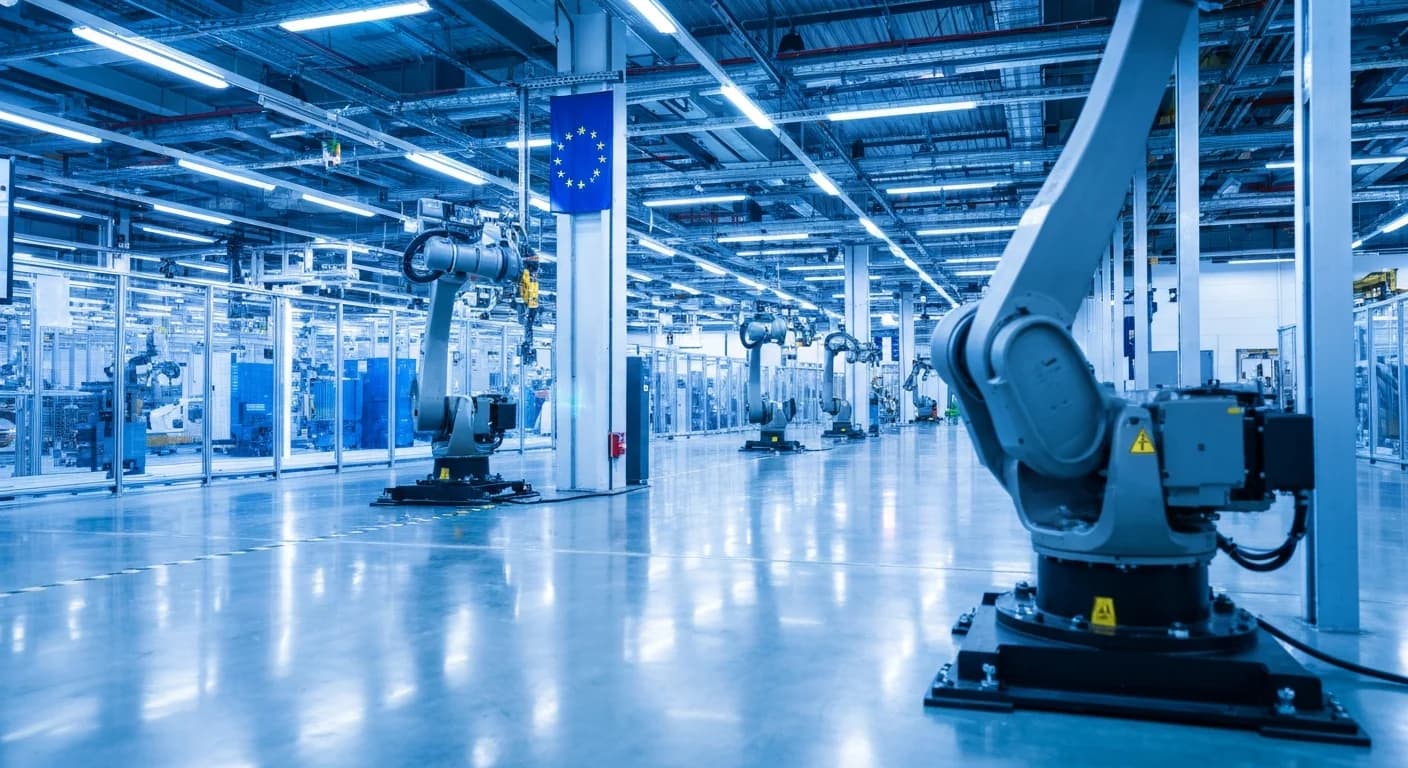
German Chancellor Friedrich Merz opened Hannover Messe on April 19, 2026 with a direct message to Brussels: treat industrial AI differently from consumer AI, or watch European factories fall further behind the United States and China. Speaking at the world's largest industrial fair, Merz said he would push the EU to loosen its artificial intelligence rulebook before the AI Act's main application date on August 2.
A Direct Challenge to the AI Act
"I will push to ease the regulatory burden in the EU on AI and, where possible, to exempt industrial AI from the current regulatory straightjacket that is too tight for AI within the European Union," Merz told attendees. He argued that AI will drive "greater efficiency and productivity, optimised use of resources and, above all, reduced costs" on the factory floor — and that the same rules designed to protect consumers shouldn't apply to machines talking to other machines.
Siemens CEO Roland Busch backed the chancellor from the same stage. "It's complete nonsense to treat industrial and machine data the same way as personal data," Busch said, echoing a complaint German industry has aired repeatedly since the AI Act was finalized.
Why the Timing Matters
The AI Act's risk-tiered obligations kick in in stages, but August 2, 2026 is the milestone when general-purpose model rules and much of the enforcement machinery come online. Merz wants an industrial carve-out locked in before that date, not after, so Europe's manufacturing base isn't subject to the same disclosure, documentation, and high-risk classification obligations that shape consumer-facing AI. For companies serving European customers, this guide to the EU AI Act August 2026 deadline business action plan walks through what to do before the deadline regardless of how the carve-out debate lands.
Germany's Compute Ambitions
The speech came paired with infrastructure commitments. Germany is targeting at least a doubling of domestic data-center capacity by 2030 and roughly a four-fold increase in AI processing capacity — from a baseline near 530 megawatts to roughly 2.1 gigawatts, according to reporting around the announcement. That build-out is meant to give German firms somewhere to run the models they're increasingly asked to deploy.
Industry Case Studies on the Floor
Hannover Messe, which hosts roughly 4,000 exhibitors, doubled as Merz's evidence locker. Microsoft and Krones showcased an AI pipeline that cut fluid-simulation time from four hours to under five minutes. ABB demonstrated a real-time industrial co-pilot ingesting factory data streams. TK Elevator showed AI agents briefing technicians on lift histories before they even arrived on-site. The common thread: these are deployments where the AI is not talking to end users at all, and where the compliance overhead built for consumer chatbots feels mismatched to the risk.
The Political Math
Merz's ask is politically awkward. The AI Act was sold in part as Europe's answer to American and Chinese deregulation, and reopening it weeks before it bites would signal that the bloc is willing to dilute its flagship digital rulebook under industrial pressure. But Germany has struggled to land major frontier-model labs on its soil, and Merz is betting that a narrower industrial rulebook is the price of keeping Siemens, Bosch, and the Mittelstand at the AI frontier rather than watching them relocate workloads to US hyperscalers.
Expect a fight. Consumer groups and members of the European Parliament who shepherded the AI Act through its final votes are unlikely to reopen the text willingly, and any carve-out will have to thread guardrails around worker surveillance, physical-safety handoffs, and autonomous control. But with the August deadline now roughly 100 days away, the pressure on Brussels has a clock attached to it.