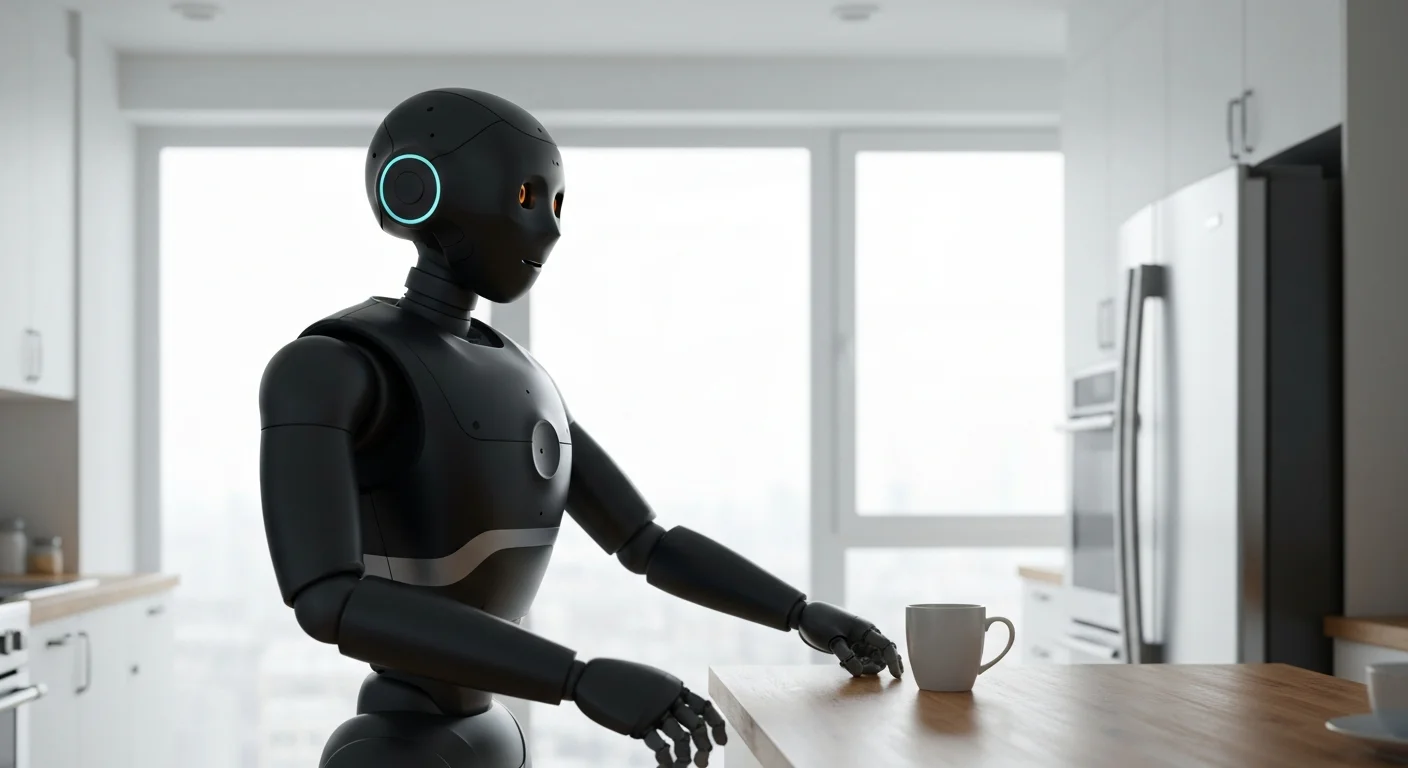
X Square Robot moved the home-robot timeline from years to weeks on Wednesday, unveiling Wall-B, the first robot built on its new World Unified Model (WUM) architecture, and pledging that deployments inside customer homes will begin within 35 days. Backed by Alibaba, ByteDance, Xiaomi and Meituan, the Chinese startup framed the launch around the slogan 'Born to Bot, Bot to Family,' positioning Wall-B not as a research demo but as a consumer-ready system entering one of the hardest environments in robotics: the unstaged home.
A single model for perception, language, action, and physics
The core technical claim is the World Unified Model. Rather than training separate stacks for vision, language understanding, motion control and physical reasoning, WUM integrates all four into one system. The model carries physics-aware predictive mechanisms that allow Wall-B to anticipate the outcome of an action before executing it, a property X Square argues is essential for an environment where no two layouts, lighting conditions, or object placements are alike.
Founder and CEO Qian Wang grounded the architectural choice in scale. 'In a home, they may need to perform 10,000 different actions, each in a different context,' he said, framing the unified model as a response to a combinatorial problem that pre-programmed trajectories cannot solve. CTO Wang Hao drew the analogy more directly to biology: 'Human infants learn by integrating perception and action at the same time, with constant feedback from the physical world.'
Trained on real households, not lab rigs
X Square Robot said Wall-B was trained on real, non-staged household scenarios rather than the curated demonstrations that dominate most embodied-AI training pipelines. That choice tracks with a broader industry shift, visible in NVIDIA's Cosmos world-models push and Physical Intelligence's pi-0.7 release, toward training data that captures the messiness of unscripted environments.
Why the 35-day window matters
A 35-day window is unusually aggressive for a humanoid platform. Most peers — from Figure to 1X to BMW's Aeon partner — have framed home entry as a multi-year arc preceded by industrial pilots. By collapsing that runway, X Square is making a bet that WUM generalizes well enough to skip the factory-first stage that competitors have treated as a prerequisite. If the deployments hold, the company will produce one of the first real datasets on how a unified embodied model behaves in private homes at any meaningful scale.
Implications
The announcement sharpens a divide that has been forming for months. Western humanoid programs have leaned on modular stacks with strong simulation pipelines and slow real-world rollouts. Chinese entrants, flush with strategic capital from the country's largest consumer-internet companies, are pushing unified architectures into customer hands faster, accepting more deployment risk to compress the learning loop. Wall-B is the clearest expression of that strategy to date — and the next 35 days will indicate whether the WUM bet is justified or premature.