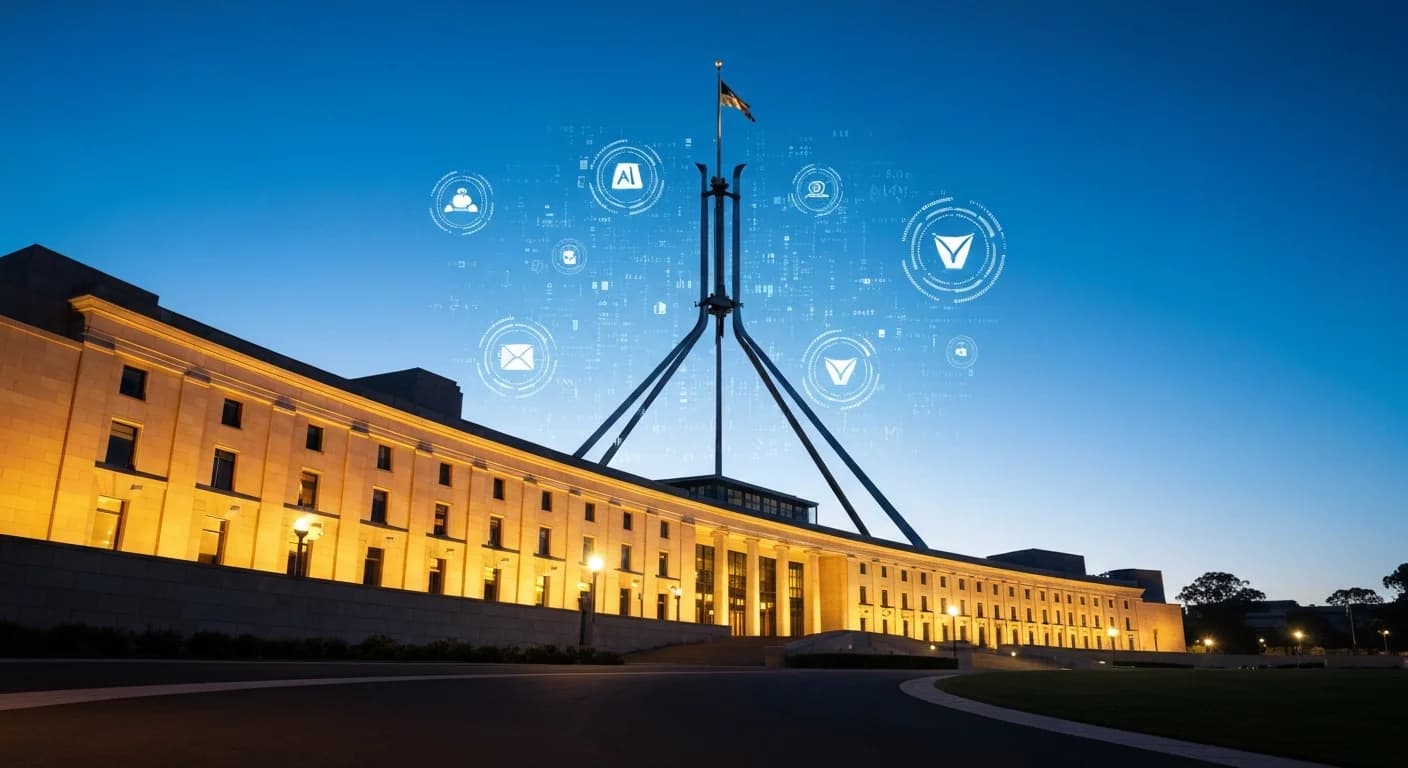
Australia's parliament has passed the AI Transparency Act, making it the first country in the world to mandate invisible watermarks on all AI-generated images, video, and audio. The law takes effect September 1, 2026, and carries fines of up to 5% of annual Australian revenue for non-compliance.
What the Law Requires
Every piece of AI-generated visual or audio media distributed in Australia must carry a C2PA-compatible invisible watermark. The requirement applies at two levels:
Generators: Companies whose AI models create the content (OpenAI, Google, Midjourney, Stability AI, ElevenLabs, etc.) must embed watermarks at the point of generation.
Distributors: Platforms that host or distribute AI-generated content (Meta, X, YouTube, TikTok) must detect and label watermarked content in their UIs. They must also reject or flag content that appears AI-generated but lacks a valid watermark.
The law explicitly excludes text-only content, private communications, and content used solely for research purposes.
The Technical Standard
The Act mandates C2PA (Coalition for Content Provenance and Authenticity) as the watermarking standard — the same framework already adopted voluntarily by Adobe, Microsoft, Google, and OpenAI. This means most major AI companies already have compatible infrastructure.
C2PA watermarks are invisible to human perception but machine-readable, surviving common transformations like screenshotting, compression, and cropping. The watermark encodes the generating model, timestamp, and a provenance chain.
Industry Reaction
The response has been mixed. Google and Adobe publicly endorsed the law, noting their existing C2PA implementations. OpenAI said it would comply but cautioned that "watermarking is not a complete solution to AI-generated misinformation."
Meta pushed back harder. A spokesperson said the company is "reviewing the law's technical feasibility" and flagged concerns about the distributor liability provisions, arguing that platforms cannot reliably detect every piece of AI-generated content that lacks a watermark.
Why Australia Moved First
The law was accelerated after a series of AI-generated deepfake scandals during Australia's 2025 state elections. Fabricated video of candidates making inflammatory statements circulated on social media for days before being debunked, and post-election analysis found that at least 12% of political content shared in the final week of campaigning was AI-generated.
"The technology to watermark AI content already exists," said Communications Minister Sarah Henderson. "The question was never technical. It was political will."
Global Implications
The EU's AI Act includes watermarking provisions but with a later 2027 timeline. The UK, Canada, and South Korea have all introduced similar bills in the past 90 days. Australia's law will serve as the first real-world test of mandatory AI watermarking at national scale.