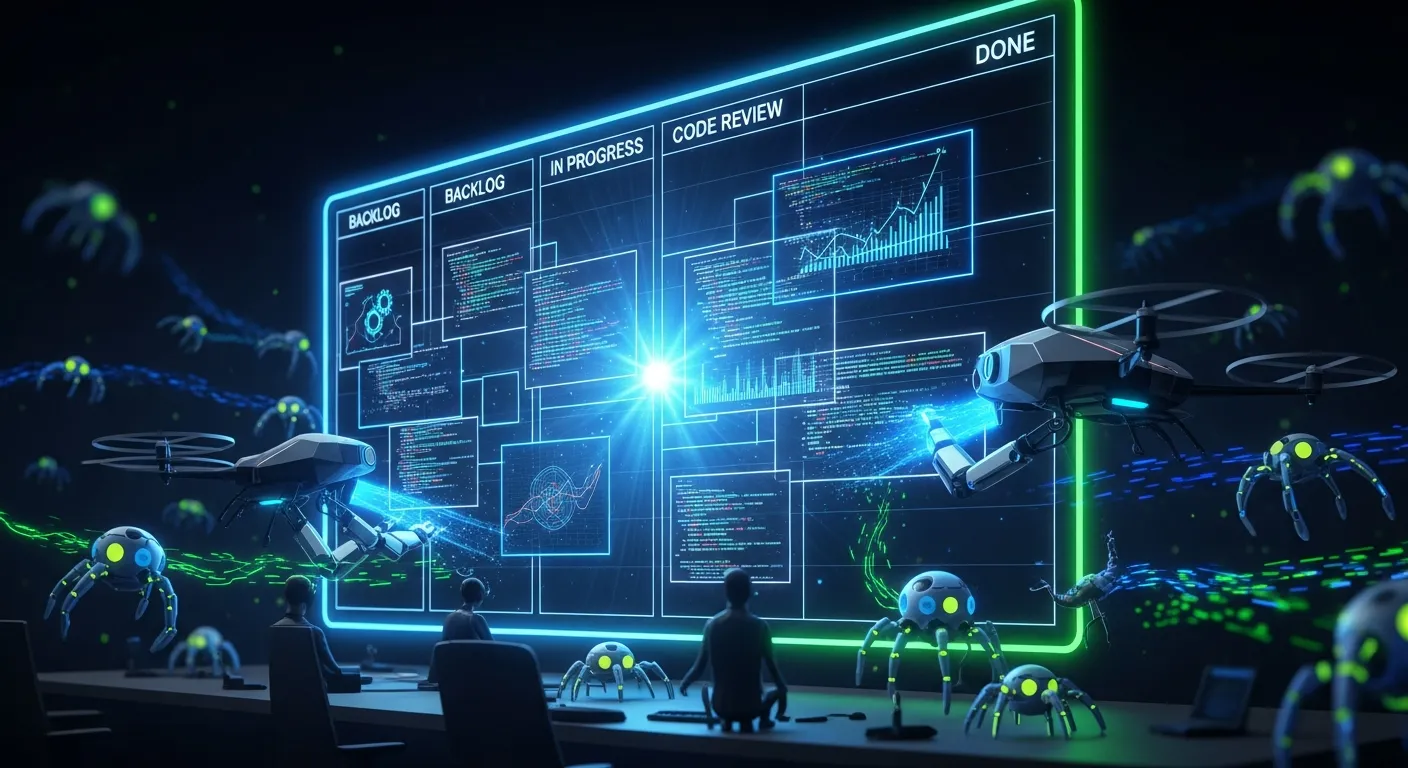
Managing one AI coding agent is a productivity boost. Managing several at once — running in parallel, handing off work between them, reviewing everything in one place — is a different kind of tool entirely.
That's what Cline Kanban is.
Cline, the popular AI coding extension, has launched a standalone app for multi-agent orchestration. It's compatible with Claude Code, OpenAI Codex, and other CLI-based coding agents. The pitch: stop babysitting one agent at a time and start running autonomous coding workflows at scale.
How It Works
The kanban board is the interface. Each card is a task. Each task runs in an isolated git worktree — its own branch, its own working directory — so multiple agents can work on the same codebase simultaneously without stepping on each other.
When an agent completes a task, you get a diff to review directly in the Kanban UI. Click to approve, reject, or request changes. No need to dig through terminals or switch contexts.
The dependency chain feature is where it gets powerful. You can link cards together: Task B doesn't start until Task A completes. Task C depends on Tasks B and D. Build out a workflow graph of agent tasks that execute in the right order, automatically, with human review gates wherever you want them.
Why This Matters
The current ceiling for AI-assisted development isn't model capability — it's orchestration. A single agent can only work on one thing at a time, and you can only supervise one agent at a time. Those constraints mean most teams are using AI coding tools for individual tasks rather than larger architectural work.
Cline Kanban removes the orchestration ceiling. You can assign parallel tasks across agents: one writes tests while another implements the feature, a third updates documentation. The dependency system ensures everything comes together in the right order.
The Bigger Picture
Tools like Cline Kanban represent the next phase of AI-assisted software development — moving from "AI helps me write code" to "AI teams work on my project while I supervise." The human role shifts from writing to directing, reviewing, and unblocking.
That shift is still early. Agents make mistakes, and every diff still needs a review. But the infrastructure for running multi-agent development workflows is arriving faster than most teams have prepared for.