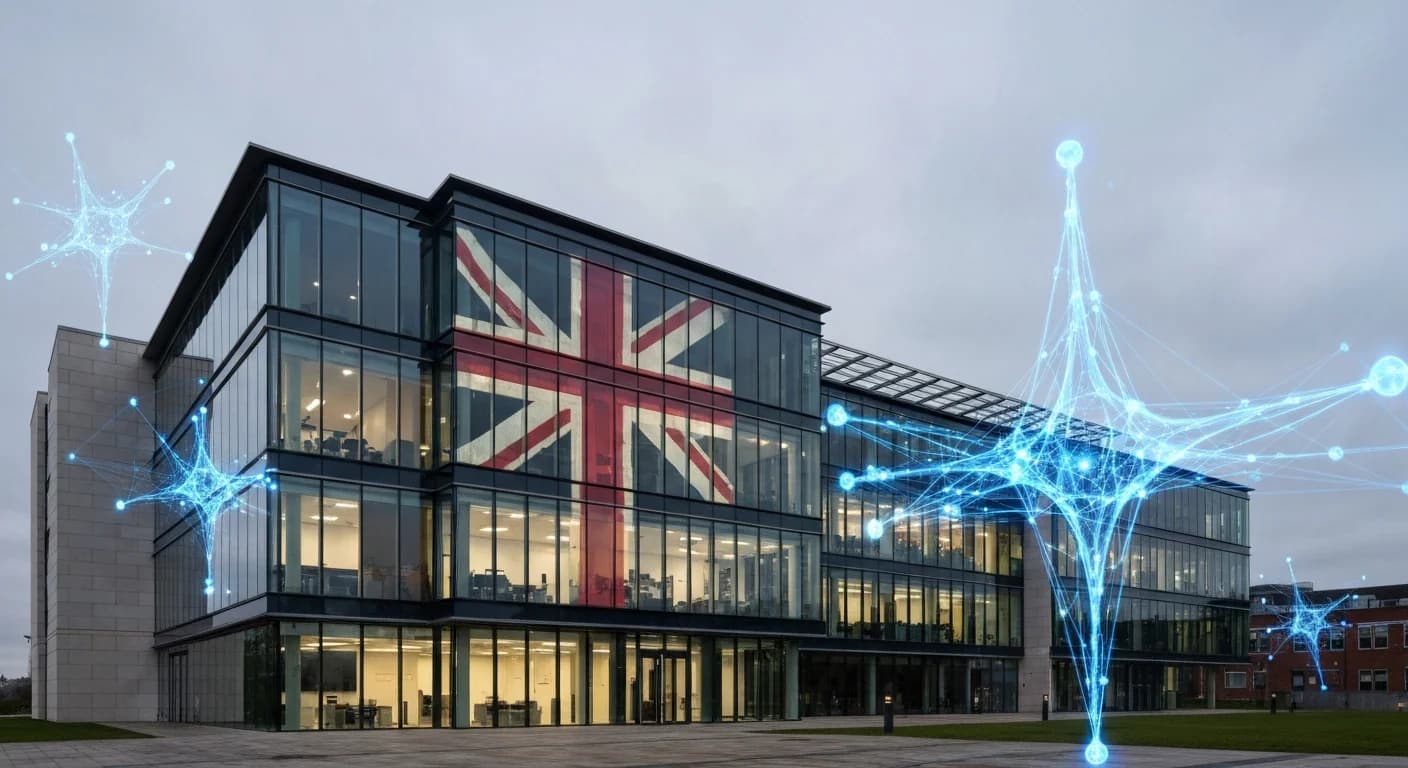
The UK government has committed up to £40 million over six years to establish a new Fundamental AI Research Lab, marking Britain's most ambitious move yet to build sovereign AI capability and reduce reliance on American technology companies.
The lab, announced on March 4 and managed by the Engineering and Physical Sciences Research Council (EPSRC), will also receive substantial in-kind access to the UK's AI Research Resource compute infrastructure, effectively adding tens of millions of pounds in additional value.
Tackling AI's Hardest Problems
Unlike applied AI initiatives focused on near-term products, the Fundamental AI Research Lab is explicitly designed for "blue sky" research targeting core limitations in today's AI systems. The research agenda includes hallucinations, unreliable memory, and unpredictable reasoning — problems that have proven stubbornly resistant to incremental engineering improvements.
The government is betting that breakthrough progress on these fundamental challenges requires dedicated, long-horizon research that commercial labs, driven by product timelines and investor expectations, are unlikely to prioritize.
The Sovereignty Angle
The lab is part of a broader £1.6 billion government plan to develop domestic AI capabilities across mathematics, engineering, and computer science. Officials have framed the initiative in explicitly strategic terms, citing the need to build "sovereign AI" that reduces Britain's dependence on Google, Anthropic, OpenAI, and other US-based companies that currently dominate frontier model development.
This positioning reflects a growing concern among European governments that reliance on American AI infrastructure creates both economic and national security vulnerabilities. The UK joins France, which has backed Mistral AI, and the EU, which has invested in open-source AI initiatives, in pursuing greater technological autonomy.
Mixed Reactions
The initiative has drawn both praise and skepticism. Supporters argue that public investment in fundamental research fills a genuine gap left by commercial labs focused on deployment. Critics have questioned whether the four-week application timeline — expressions of interest due by mid-March, full applications by March 31 — is realistic for a project of this ambition and scope.
Some researchers have also noted that £40 million, while significant for academic research, is a fraction of what leading AI companies spend on a single training run. The lab's impact will depend heavily on how effectively it leverages its compute access and attracts top talent willing to pursue long-term research goals.
What Comes Next
The EPSRC is currently reviewing expressions of interest, with the lab expected to be operational later in 2026. Its success could set a template for how mid-sized nations compete in AI — not by matching the scale of US and Chinese investment, but by targeting fundamental research breakthroughs that shift the entire field forward.